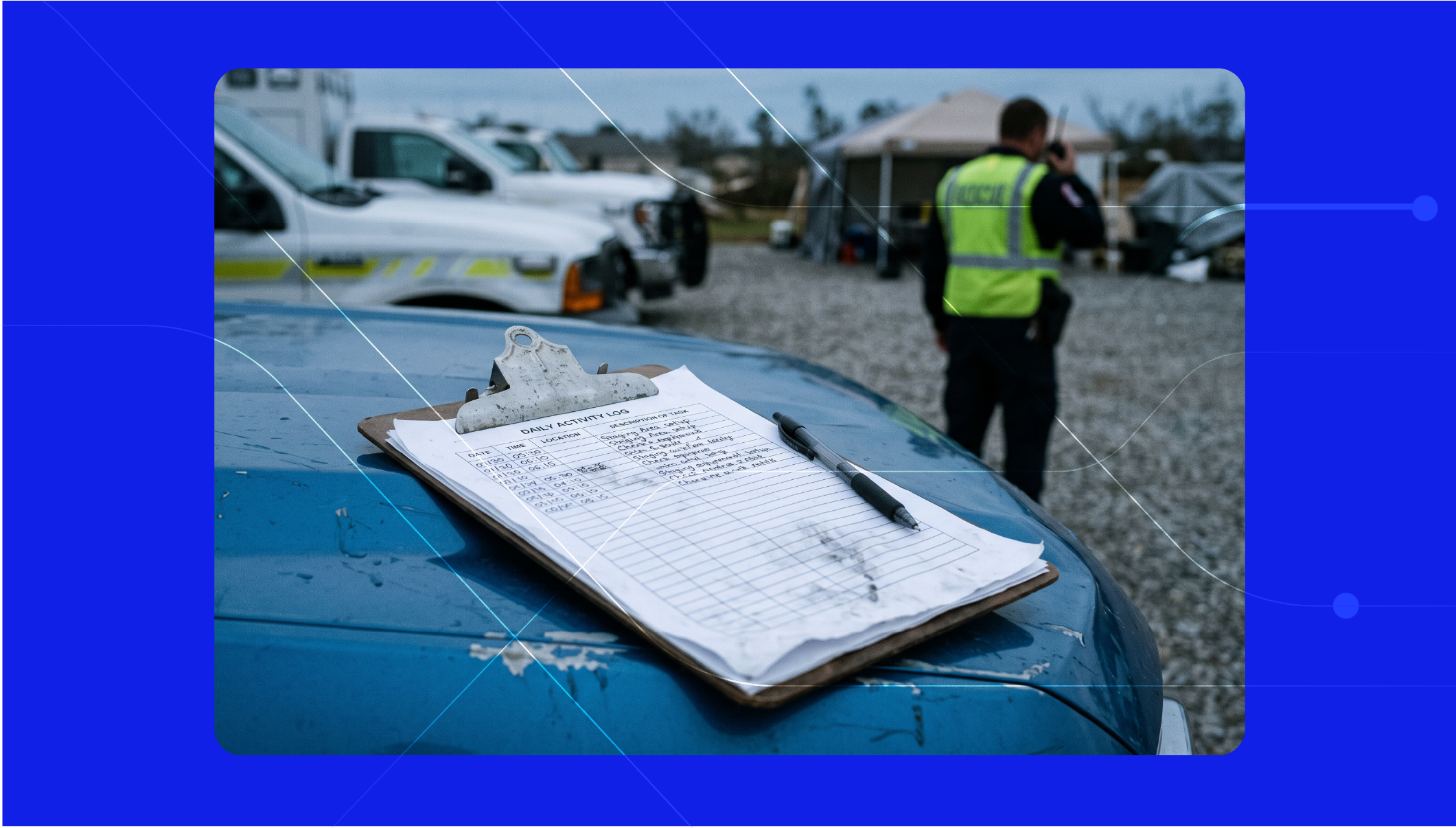
A response goes well. The resources show up, the immediate crisis gets handled, and everyone moves on to the next thing. Then, months later, the reimbursement claim comes back rejected. Or it just sits, unresolved, because of a gap on an ICS-214 that nobody thought twice about at the time.
If you work in emergency management, you know this form. The Activity Log. ICS-214. It's about as standard as NIMS documentation gets, a record of what a resource, an individual, a crew, a piece of equipment, actually did during an incident, broken out by operational period. Everyone fills them out. And yet they're also one of the most common places a Public Assistance claim quietly falls apart, not because the work wasn't real, but because the daily record of it wasn't clean enough to hold up months later.
Why This Keeps Happening
FEMA is specific about what it wants to see. The Public Assistance Guide requires a description of work performed for each individual, supported by a daily log and activity reports. So your ICS-214s aren't just an internal tool for tracking who did what. They're evidence. Auditors use them to confirm a claimed cost actually happened the way it was reported.
That's a lot to ask of a form that usually gets filled out in the middle of a response, by someone whose actual job in that moment has nothing to do with paperwork.
We've heard versions of the same story more than once. One emergency management office spent years trying to build a digital version of the 214 internally, working with their own IT team, only to watch the project stall every time a key staff member left or moved on. Eventually it just got shelved. Nobody decided to give up on it exactly. It just never made it across the finish line before something else took priority, and it's worth asking how many agencies have quietly lived through some version of that same story.
There's also a review problem sitting underneath the paperwork problem. Whoever signs off on a 214 usually isn't a specialist in the work being described. If a public works crew reports using a certain quantity of material and the number is off by a factor of ten, there's a decent chance nobody catches it before the claim goes out the door, because the reviewer doing the approving isn't an engineer and has no independent way to check. That kind of error tends to surface later as a request for more information from FEMA, at which point the person who actually knew the answer may already be on a different assignment, or gone entirely.
And sometimes the ICS-214 doesn't even agree with an agency's own other systems. Dispatch and CAD platforms already log a lot of this activity automatically, when someone responded, where, for how long. When that automated record doesn't match what's written on a manually completed 214 for the same event, that's no longer just a documentation inconsistency. It's a discoverable one. Two official records of the same incident that don't line up is exactly the kind of thing an attorney goes looking for.
None of this is limited to the agency that's directly managing a response, either. Mutual aid runs on trust and speed, and both depend on an agency's ability to show, on short notice, exactly what a deployment will cost. When that information is scattered across spreadsheets, emails, and a patchwork of prior agreements, a team can lose the chance to deploy at all. Not because they weren't capable. Because they couldn't pull together a confident answer fast enough when someone actually asked.
Zoom out from any single agency's story, and the pattern holds at the federal level too. When DHS's Office of Inspector General audits Public Assistance grants, the same handful of findings shows up again and again: poor contracting practices, unsupported costs, poor project accounting, duplicate benefits, excessive equipment or labor charges. Almost all of it traces back to the same root issue. The paperwork that was supposed to back up a cost either wasn't complete, wasn't consistent, or wasn't written down when the work actually happened.
The dollar amounts involved aren't small, either. One Texas county had $44.6 million in debris removal contracts flagged during an OIG audit over procurement issues; FEMA's own review still ended up docking about $9.1 million as unsupported. A Puerto Rico authority had more than $62,000 in questionable costs turn up in a single audit, a good chunk of it simply unsupported by adequate records. These aren't rare, unlucky outcomes. They're what happens when documentation actually gets reviewed closely.
The Most Common ICS-214 Mistakes That Cost Agencies Reimbursement
A new form doesn't get started for every operational period. The ICS-214 is built around a specific window of time. When activity from multiple periods gets logged on one form, or carried forward informally instead of starting fresh, that's usually the first inconsistency an auditor notices.
The home agency and department field is incomplete, or just wrong. It sounds minor. It isn't, because that field is part of how a cost gets tied back to the right applicant and program. Some agencies have had to go back and manually correct that field on forms they'd already submitted, which is a slow, entirely avoidable kind of rework.
The activity description is too thin, or written too late to be useful. A log filled in from memory at the end of a shift, or worse, weeks after the response wraps up, tends to flatten out details in a way that doesn't hold up as real support for a specific cost. This is usually what triggers a follow-up request from FEMA. And by the time that request lands, the person who could actually fill in the gap may not be around anymore, or the memory just isn't sharp enough to trust.
Quantities and units get recorded wrong, and nothing downstream catches it. Someone approving a crew's submission usually isn't in a position to know whether a number is accurate. Without some kind of check built into the process itself, an error like that can ride all the way through to submission.
The 214 doesn't match what other systems already show. Plenty of agencies have a dispatch or CAD system that's already tracking a lot of this automatically. If that record and the ICS-214 tell two different stories about the same event, that's not a paperwork problem anymore. It's a liability one.
Continuation sheets aren't paginated or referenced properly. When an incident runs long enough that one form isn't sufficient, official guidance calls for continuation sheets with consistent pagination. Skip that step, and you've created a gap nobody can fill in after the fact.
Completed forms never quite make it to the Documentation Unit. The process assumes every finished original gets filed centrally. When that depends entirely on someone remembering to hand it off, some forms just don't make it. And a missing 214 might as well not have existed. It's often exactly this kind of gap that forces an agency to bring in outside consultants after the fact, paying someone to reconstruct records that should have been right the first time.
The Institutional Knowledge Risk
Here's something worth sitting with. Before 2018, FEMA's ability to claw back money it had already paid wasn't limited to some short window after the fact. It could happen essentially anytime, sometimes years later, often triggered by an OIG audit that had nothing to do with the original response team. The Disaster Recovery Reform Act changed that, capping recoupment to three years. Better, sure. But three years is still plenty of time for the people who actually filled out the original 214s, the ones who understood the context behind every entry, to have retired, changed jobs, or just forgotten the details.
That's exactly the gap that turns a defensible expense into a costly clawback. You can't prove when a piece of equipment was used if the log was written from memory days later. You can't reconstruct a consistent record across dozens of individual forms if the one person who knew how your agency typically filled them out is gone. And if your whole ability to catch these problems before submission rests on one experienced staff member, that safety net disappears the day they leave.
Some agencies are still running this entire process on paper, literally hand-written checks and warrant numbers, even in departments that have modernized nearly everything else. One emergency manager described it well: the agency operates like a modern organization most of the time, and then a response happens, and suddenly it's like stepping back into the 1970s.
Best Practices for Real-Time ICS-214 Documentation
The fix here isn't more review after the fact. It's better information the first time, captured while the response is actually happening.
1. Log activity in real time, not from memory later. The longer the gap between doing the work and writing it down, the more gets lost or smoothed over. Even a brief note logged in the moment beats a detailed reconstruction days later.
2. Build your format before the next disaster, not during it. Agencies that lock in a consistent digital template ahead of time, with the required fields already structured correctly, spend a lot less time fixing mistakes under pressure.
3. Put a second set of eyes on every form before it moves forward. Someone other than the person who filled it out should check it for completeness, ideally before it heads to the Documentation Unit, not after.
4. Design for people who aren't sitting at a desk. A lot of field and frontline staff don't have easy computer access, and any process that assumes otherwise will get skipped the moment things get busy.
5. Make routing automatic. If a completed form only becomes part of the official record when someone remembers to hand it off, that's not really a process. It's a habit, and habits don't survive turnover or a chaotic week.
Building a Repeatable Process Before the Next Disaster
The agencies that recover funding reliably aren't necessarily the ones with the most experienced staff. They're the ones whose process doesn't depend on any one person being around, because the workflow itself carries the institutional knowledge forward instead of a person's memory.
That means a standardized digital format used the same way every time. A structured way to capture equipment, personnel hours, and mutual aid activity as it happens, not reconstructed later. A built-in review step that doesn't rely on someone remembering to check. And a system that actually works for people out in the field, not just people back at a desk.
None of this has to wait for the next disaster. The agencies best positioned to survive an audit three years from now are the ones already treating documentation as part of preparedness, something their own team owns and adjusts, rather than something rebuilt from scratch, or handed off to a consultant, every time a requirement changes.
Real Examples: What Strong Grant and Reimbursement Administration Looks Like
Guilford County, NC stood up its ARPA recovery program in a single week and ultimately delivered $58 million in pandemic recovery funding through an 8-step review process spanning multiple departments. The review itself was visible and trackable from day one. It wasn't pieced together after the money was already moving.
New Castle County, DE had even less runway. It had to distribute $322 million in CARES Act funds and be fully operational and compliant within 48 hours. The program later passed external audit, which happened because the documentation was structured correctly from the very first submission, not cleaned up afterward.
North Las Vegas, NV distributed close to $20 million in CARES funding by repurposing existing staff, including library employees, to process tens of thousands of submissions in just a few weeks. That kind of speed only works when the process itself is doing the heavy lifting, not specialized knowledge that lives in one or two people's heads.
Different disasters, different dollar amounts, same underlying pattern. None of it came down to more staff or more time. It came down to a documentation process built to hold up under review from day one.
Where to Go From Here
If your agency has had a FEMA claim rejected or delayed recently, go back and look closely at the ICS-214s tied to it. Missing operational periods. Incomplete department fields. Entries that read like someone was reconstructing the day rather than logging it as it happened. If the gap traces back to one person's habits, or their memory, that's the real problem, and it isn't solved by finding more careful people. It's solved by building a system that gets the record right the first time, and keeps it defensible three years down the road.
SimpliGov is the platform where emergency management teams design, run, and improve ICS-214 activity logs, mutual aid requests, and reimbursement documentation, so funding recovery doesn't depend on reconstructing details after the fact, or on any one person being there to catch what would otherwise slip through. See how it works.