Expectations of government programs have changed. Constituents expect faster answers, leadership expects performance data on request, and auditors expect a complete record of every decision. Most case-intensive programs still coordinate their work the way they did before anyone asked for those things.
If you run a program in child services, social services, health and human services, or benefits eligibility, you carry a kind of accountability your peers in other departments rarely face. You are responsible for outcomes you often cannot see, prove, or control. The pressure you feel is a reasonable response to how the work is set up.
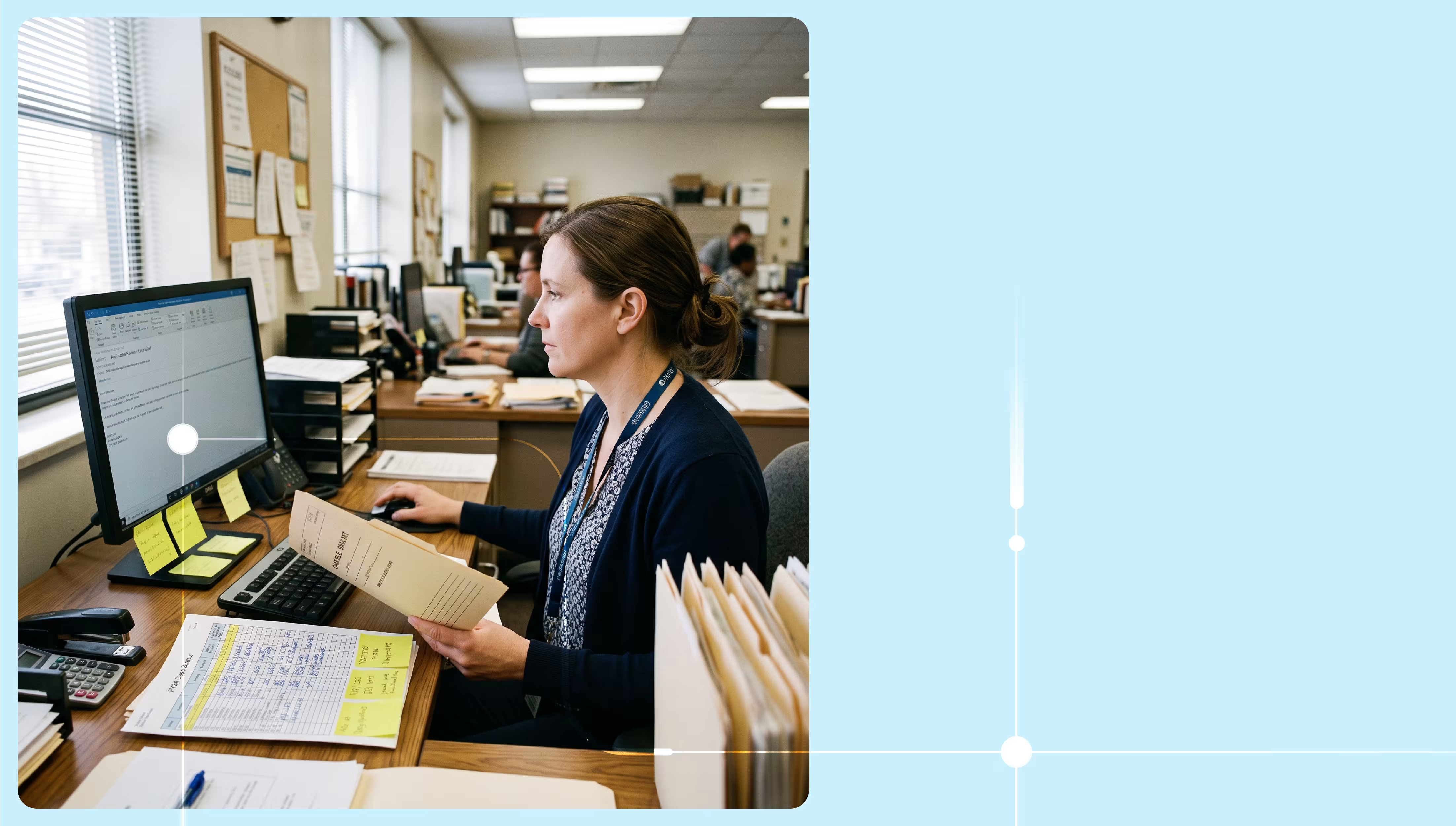
The work that connects intake to resolution happens outside any system built to track it. Email and spreadsheets are good tools, and your staff use them well. What they can’t do is show where a case stands right now, record who handed it to whom, or keep working after the person who built them leaves. A case may be moving, and you may have no way to tell. When a delayed case becomes a constituent complaint, when staff burn out on tasks that don’t move cases forward, or when an audit asks for records the operation never captured, the pressure lands on you. Most of the time, the cause is how the work is structured.
Where the work goes unrecorded
A case moves from intake to eligibility determination to service delivery to closure. At every handoff, someone is chasing a document, reconstructing case history, or updating a status field by hand. That work is real, and it leaves no trace anywhere you can look.
So you can’t see where cases sit, which ones are aging, what is slowing them down, or who holds them. You can ask, but asking interrupts someone, and the answer is only as current as the last time they checked their inbox or their tracker.
Staff spend their days on the work around the work
Chasing documents, updating trackers, rebuilding case history from email to answer a supervisor’s question: these tasks take hours and produce no case progress. They are the work around case management, and they wear down experienced staff.
Because that load goes unrecorded, it doesn’t show up in any measure. A caseworker can look fully tasked by caseload, appointments, and documentation and still be overwhelmed, because half the day goes to handoffs nobody counts. The tracker that kept a team running often lives on one person’s desktop, organized in a way only they understand. When that person leaves, the tracker and what they knew go with them, and the program gets harder to run.
Performance you can’t show
A program may be performing well, and you may know it. When leadership asks for evidence, you are rebuilding records by hand.
How many cases closed within the statutory window? You can answer once someone pulls case files and builds a spreadsheet for the occasion. Which cases are at risk of missing a deadline? You find out when the deadline passes, because no one’s tracker flags it in time. Where are the bottlenecks? You can guess from complaints, but you can’t point to data. Every request for evidence starts another manual reconstruction, and the program can’t improve what it can’t measure.
When a case becomes public
A delayed case surfaces as a news story or a council question, and you are asked to explain a process you couldn’t see either. Nobody lost the case or made an error. It sat in someone’s queue, waiting on a step no one else knew about.
When a case reaches the public before it reaches you, the gap is yours to explain, even though the cause was structural.
The compliance stake
Auditors ask for evidence that the program followed its own process. When that process lived in email threads and personal trackers, the evidence was never created. Every case has a file. Few have a record of the handoffs, approvals, exceptions, and corrections that moved it from intake to resolution.
You can rebuild some of it by searching email and asking staff what they remember. Auditors can tell a record kept as the work happened from one assembled afterward. What worries most directors is a program that did the right thing and can’t show it.
What changes when the work is visible
The pressure program directors carry is a structural consequence of coordination work that no system records. More effort won’t close that gap. Visibility will.
SimpliGov is a government operations platform that program teams use to design, run, and improve the processes behind their programs, without waiting on IT.
Your team turns forms and handoffs into defined processes, so applications, documents, approvals, and decisions move through every required step. You can see where each case sits, what is aging, and what is holding it up. Approval paths, exceptions, and policy logic live in the system rather than in inboxes or in the memory of staff who may leave. Every step is recorded as it happens, so the audit trail exists before anyone asks for it.
When coordination is structured and visible, you stop answering for work you can’t see and start owning how work moves through your program.